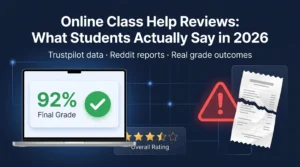
Online class help reviews in 2026 show a pattern split between students who received genuine deadline support and those who lost hundreds of dollars to services that failed to deliver. Trustpilot data for TakeOnlineClassHelp shows 3.5/5 from 71 reviews, with a documented June 2026 complaint involving an $800 payment and zero completed work.
The split tells you everything about this industry. Some students finish full degree programs in months through legitimate services. Others pay upfront, get ghosted, then face blackmail when they ask for refunds. The difference between those two outcomes comes down to which service they chose and how carefully they vetted it before paying.
Here’s what the reviews actually show across Trustpilot, Reddit, and independent forums in 2026 – and what the positive cases have in common that the negative cases don’t.
What Do Online Class Help Reviews Actually Show in 2026?
Online class help reviews in 2026 split into two distinct categories: students reporting successful course completion with grades above 85%, and students reporting upfront payments of $200-$800 with no completed work, no refund, and in some cases, threats to report them to their university. The review data on Trustpilot and Reddit shows both patterns running simultaneously across the same search results.
The positive review pattern contains specific details. Students name the platform – Sophia Learning, StraighterLine, Canvas, Blackboard – and describe the grade outcome with a number. “Completed my 20 Sophia Learning courses with grades above 90%” tells you something verifiable. A review that says “great service, highly recommend” with no specifics tells you nothing. Generic praise without grade outcomes or platform names signals a curated testimonial rather than a genuine student experience.
The negative review pattern also contains specific details, but of a different kind. A June 2026 Trustpilot complaint against TakeOnlineClassHelp documents an $800 payment, no completed assignments, and a refusal to issue a refund despite a stated guarantee. EssayScam.org hosts a documented case where a service promised an A on a quiz and final, delivered Ds in both, then threatened to report the student to their university unless they paid an additional $990. These aren’t isolated incidents – they represent a documented operational pattern in a segment of this industry. The review picture for OnlineClassHelp.xyz sits at 3.2/5 from 9 reviews, with 67% of those reviews at one star. That ratio on a thin review base signals a service where most paying customers had a bad experience significant enough to motivate a public negative review.
Which Online Class Help Services Have the Strongest Independent Reviews?
The strongest independent reviews for online class help services appear on Trustpilot, Sitejabber, and Reddit – not on the service’s own website. Services with 100+ independent Trustpilot reviews, a rating above 4.0/5, and company responses to negative feedback pass the baseline credibility test. Services with fewer than 20 independent reviews, all five-star ratings, and no negative feedback have almost certainly curated their review profile.
The review platform matters as much as the rating. Trustpilot allows unverified reviews but also allows the company to respond and flag disputes. Reddit allows zero moderation by the service being reviewed, which is why Reddit threads contain the most unfiltered student experiences. A service with strong Trustpilot ratings but no Reddit presence deserves scrutiny – genuine student experiences tend to surface across multiple platforms simultaneously.
Sitejabber hosts thousands of reviews for some online class help services, but some services report dramatically different ratings on Sitejabber versus Trustpilot. That divergence signals selective review solicitation – the service asks satisfied customers to leave reviews on one platform while unhappy customers gravitate to another. Cross-referencing all three platforms before paying gives you a more accurate picture than any single source. Eexamly takes a different approach entirely: instead of managing a review profile, the service publishes completed grade screenshots across platforms – actual course records from Sophia Learning, StraighterLine, McGraw-Hill Connect, and 12+ other platforms that any prospective student can view before committing to a single payment.
What Positive Reviews Have in Common
Positive reviews from verified students share four characteristics. First, they name the specific course platform – ALEKS, Canvas, Sophia Learning, WGU – rather than describing vague “online coursework.” Second, they state a grade outcome with a number: “finished with 92%,” “got a B+ on the final,” “all 20 courses above 90%.” Third, they describe the communication process: “kept me updated weekly,” “responded within 2 hours,” “explained the timeline before starting.” Fourth, they mention the payment structure: “paid per course after seeing the grade” or “paid weekly and could see progress before each payment.”
Positive reviews that lack all four of these elements may reflect genuine satisfaction, but they provide no useful information for evaluating whether a service will work for a different student’s specific course and platform.
What Negative Reviews Have in Common
Negative reviews cluster around three failure patterns. The first is upfront payment followed by communication breakdown – the service collects full payment, delivers partial work or nothing, then stops responding. The second is quality failure – work gets delivered but contains incorrect answers, misses assignment-specific instructions, or gets flagged by the university for quality inconsistency. The third and most serious is the credential leverage pattern: the service has university login details and uses the threat of reporting the student as leverage when the student asks for a refund or complains about quality.
What Red Flags Appear Repeatedly in Negative Online Class Help Reviews?
The three red flags that appear most consistently in negative online class help reviews are: full upfront payment required before any work begins, “guaranteed A” promises on proctored exams, and payment requested via gift card, wire transfer, or cryptocurrency. Any single one of these signals a service operating without accountability. All three together signal a scam operation.
Full upfront payment removes the service’s only accountability mechanism. Once the payment clears through an untraceable channel, the student has no financial recourse. Standard payment gateways – Visa, Mastercard, PayPal – allow dispute resolution and chargeback processes. Gift cards and wire transfers do not. A service insisting on the latter knows it’s removing the student’s ability to recover funds if the work doesn’t arrive.
“Guaranteed A” on proctored exams is a promise no legitimate service can make. Respondus and Honorlock monitoring systems verify student identity through webcam, facial recognition, and browser lockdown. A third party logging into a proctored exam faces immediate detection risk. Services making this promise are either planning to attempt it (high risk to the student’s enrollment) or planning to take the payment and deliver nothing while citing “technical difficulties” with the proctored environment. The EssayScam blackmail case began exactly this way – a service promised guaranteed grades on proctored assessments, failed to deliver, then used the student’s own credential sharing as leverage. Students who need quiz and assessment support should work with services that are transparent about what they can and cannot handle, rather than ones that promise outcomes on monitored systems.
The login credential issue deserves specific attention. Canvas, Blackboard, MyMathLab, and every major LMS tracks login IP addresses and device fingerprints. Unverified third parties accessing these accounts create detectable anomalies. A service using a VPN to match regional IP addresses reduces but doesn’t eliminate this detection risk. More critically, handing login credentials to an unverified service gives that service leverage over the student. If the relationship turns adversarial, the service holds access to the student’s entire academic record. Legitimate tutoring services don’t need your university login – they work from the syllabus and assignment prompts you provide. Any service requiring full LMS credential access for standard tutoring or assignment support has structured itself for access rather than assistance.
How Do You Verify Whether an Online Class Help Review Is Reliable?
A reliable online class help review contains four verifiable elements: the specific course platform used, a numerical grade outcome, a description of the communication process, and information about when and how payment was made. Reviews missing all four elements provide no useful signal about whether a service will work for a different student’s specific situation.
The 10-minute verification process before paying any online class help service starts with a Trustpilot search. Filter by “most recent” rather than “most relevant” – the relevance filter surfaces algorithm-weighted older reviews, while recent reviews show current service quality. Read the most recent 20 reviews and count how many contain platform names and grade outcomes versus how many contain only general praise.
Search the service name plus “reddit” and “scam” as separate queries. Reddit surfaces unfiltered experiences within days of an incident. A service with no Reddit presence and 500 five-star Trustpilot reviews hasn’t been tested at scale in unmoderated environments – that absence is a signal. A service with active Reddit discussion, including some complaints, has a track record you can evaluate. The complaint details matter: a complaint about slow communication is different from a complaint about credential misuse or failed refund on a $600 payment.
Check the domain age and business identity. Services with domains created within the past 12 months and no verifiable business address or phone number have no track record to evaluate. Established services list working contact information, a refund policy with specific conditions, and a business structure you can verify. Ask directly before paying: what is the refund condition if the grade falls below the agreed level? A service that cannot answer this with a specific number and timeline has no refund infrastructure.
The most reliable verification signal is published grade evidence. Eexamly’s completed course record page shows actual grade screenshots from specific platforms – Sophia Learning courses graded at 91%, 94%, 88% – rather than written testimonials the service controls. That level of transparency lets prospective students evaluate quality evidence before making any payment decision.
What Scam Patterns Appear Most in Online Class Help Complaints?
The most documented scam pattern in online class help complaints follows a four-step sequence: collect full upfront payment via untraceable method, deliver partial or no work, refuse refund citing vague policy terms, then use credential access as leverage if the student escalates. This pattern appears in EssayScam.org documentation, Trustpilot complaint threads, and Reddit’s r/Scams forum across multiple service names and years.
The credential leverage pattern deserves specific emphasis because it causes harm beyond the financial loss. Once a service holds university login credentials and has evidence of a student attempting to outsource coursework, it holds a coercive position. The EssayScam-documented case involved a $990 additional payment demand under threat of university reporting. The student faced a choice between paying more money to a service that had already defrauded them or risking academic misconduct proceedings. Neither option appeared when they paid the initial amount.
A second documented pattern involves grade manipulation on partial deliveries. The service completes the first 2-3 weeks of coursework adequately, building trust and sometimes a positive Trustpilot review from the student. It then delivers declining quality on later assignments while requesting additional payment for “upgraded” service or citing unexpected workload increases. By the time the quality failures affect the final grade, the student has paid the full amount and the semester deadline makes switching services impossible.
The mid-semester lock-in is a structural problem this industry creates for students who commit to full-course services upfront. Reddit discussions specifically advise against switching services mid-semester because the incoming service lacks course context and the outgoing service may withhold access to progress notes. The payment model that eliminates this risk is pay-per-course or pay-after-results – where each payment decision happens only after the previous result is confirmed. Eexamly structures every engagement this way: you pay for one completed online course after the grade is confirmed, then decide on the next one independently. One client paid $110 per course across 20 Sophia Learning courses, seeing each grade before committing to the next – $2,200 total for a full degree program, each payment made with verified evidence in hand.
What Does Legitimate Online Class Help Look Like vs. a Scam Service?
Legitimate online class help separates itself from scam operations through five verifiable attributes: per-course or per-result payment structure, grade evidence published publicly before any payment request, subject-specific expert matching rather than generic assignment writers, a refund condition stated with specific numbers and timelines, and standard payment gateways that allow dispute resolution.
The comparison below reflects documented differences between service categories – not promotional claims:
| Attribute | Legitimate Service | Scam Service |
| Payment timing | After grade confirmed | Full upfront, untraceable method |
| Grade evidence | Actual screenshots publicly published | Written testimonials on own website |
| Expert matching | Subject-specific, platform-experienced | Generic “academic writers” |
| Refund condition | Specific: “below B = refund in 7 days” | Vague: “satisfaction guaranteed” |
| Payment gateway | Visa, Mastercard, PayPal | Gift cards, wire transfer, crypto |
| Contact before payment | Working phone, live chat response within 2 hours | Email only, 24-48 hour response |
| Credential requirement | Works from syllabus, no LMS login needed | Requires full university login access |
Starting with a low-commitment task before any full-course engagement is the most reliable personal verification method. A single homework assignment costing $20-$50 produces actual evidence of expert quality, communication speed, and delivery reliability before you commit to anything larger. Any legitimate service accepts single-task requests without requiring full-course commitment.
For students who want to use online support within clearly legitimate academic parameters,online tutoring and proofreading services carry no detection risk because the student remains the author of every submission. These forms of support fall within permitted academic assistance at virtually every institution and provide genuine skill development alongside grade support.
What Should You Do If an Online Class Help Service Scams You?
If an online class help service takes your money and fails to deliver, your first action is a payment dispute through your credit card or PayPal before the chargeback window closes – typically 60-120 days from the transaction date. Filing a dispute is faster and more reliable than attempting to negotiate a refund directly with a service that has already refused to return money.
Document everything before filing the dispute: screenshots of the original payment, all communication threads, the service’s stated refund policy at the time of payment, and any evidence of non-delivery or quality failure. Payment processors require documentation to support disputes, and organized evidence increases the probability of a successful chargeback.
If the service has your university login credentials, change your LMS password immediately – before filing any dispute. A service that turns adversarial after a payment dispute may attempt to access your account or use that access as leverage. Notify your university IT security team that an unauthorized third party may have had access to your account, framing it as a security concern rather than an academic integrity admission. Most universities investigate credential security incidents separately from academic misconduct proceedings.
Do not pay additional money under any threat to report you to your university. Document the threat – screenshot it with timestamp – and consult your university’s student affairs office about the situation. Universities handle coercive external threats differently from academic misconduct cases initiated through their own detection processes. Legal academic support going forward starts with subject-specific tutoring that keeps the student as the author of their own work and removes the credential leverage problem entirely.
Frequently Asked Questions About Online Class Help Reviews
Are online class help reviews on Trustpilot reliable?
Trustpilot reviews for online class help services carry moderate reliability. The platform allows unverified reviews, meaning neither the reviewer’s student status nor their course outcome gets confirmed independently. Filter by “most recent” and look for reviews containing specific platform names, grade numbers, and communication details. Reviews stating only “great service, highly recommend” without specifics don’t provide useful information about whether a service will work for your specific course and platform.
Why do some services have thousands of positive reviews but still get scam reports?
High review volume doesn’t eliminate scam risk for two reasons. First, services can solicit reviews from the subset of satisfied early customers while later-period customers have worse experiences as the operation scales or degrades. Second, some services use incentivized review programs that inflate positive review counts while negative experiences appear on different platforms. Cross-referencing Trustpilot with Reddit and EssayScam.org gives a more complete picture than any single platform.
What is the safest way to use an online class help service without getting scammed?
The safest approach combines three practices: pay after results rather than upfront, start with a single low-cost task before any full-course commitment, and use standard payment gateways that allow dispute resolution. A single quiz or assignment costing $30-$60 gives you real quality evidence before any larger financial commitment. Services that refuse to accept single-task orders or insist on full-semester payment upfront have removed their accountability structure before the relationship begins.
Can my university tell if someone else completed my online class?
Universities detect outsourced coursework through multiple mechanisms: LMS login anomalies (unusual IP addresses, device fingerprints), writing inconsistency between assignments submitted over time, knowledge-verification questions during or after submissions, and document metadata. The detection risk scales with how closely the institution monitors that specific assessment type. Self-paced platforms like Sophia Learning and StraighterLine use different monitoring than traditional universities with proctored finals. Knowing your specific institution’s monitoring approach matters before making any decision about external academic support.
Does Eexamly have student reviews I can check?
Eexamly publishes grade screenshots rather than written testimonials – actual course record screenshots from Sophia Learning, StraighterLine, McGraw-Hill Connect, and 12+ other platforms showing specific grade percentages across completed courses. The samples page shows these records publicly, and the pay-after-results model means every new client sees one completed course grade before paying for the next. That structure makes the review question secondary – the grade evidence comes before the payment, not after.