Academic help covers tutoring, coaching, writing support, exam preparation, peer mentoring, and AI-assisted learning tools. The right option depends on what’s blocking a student’s performance not on what’s most popular or most expensive. Students who identify their exact gap first consistently get more value from any support they choose.
What Types of Academic Help Do Students Actually Need?
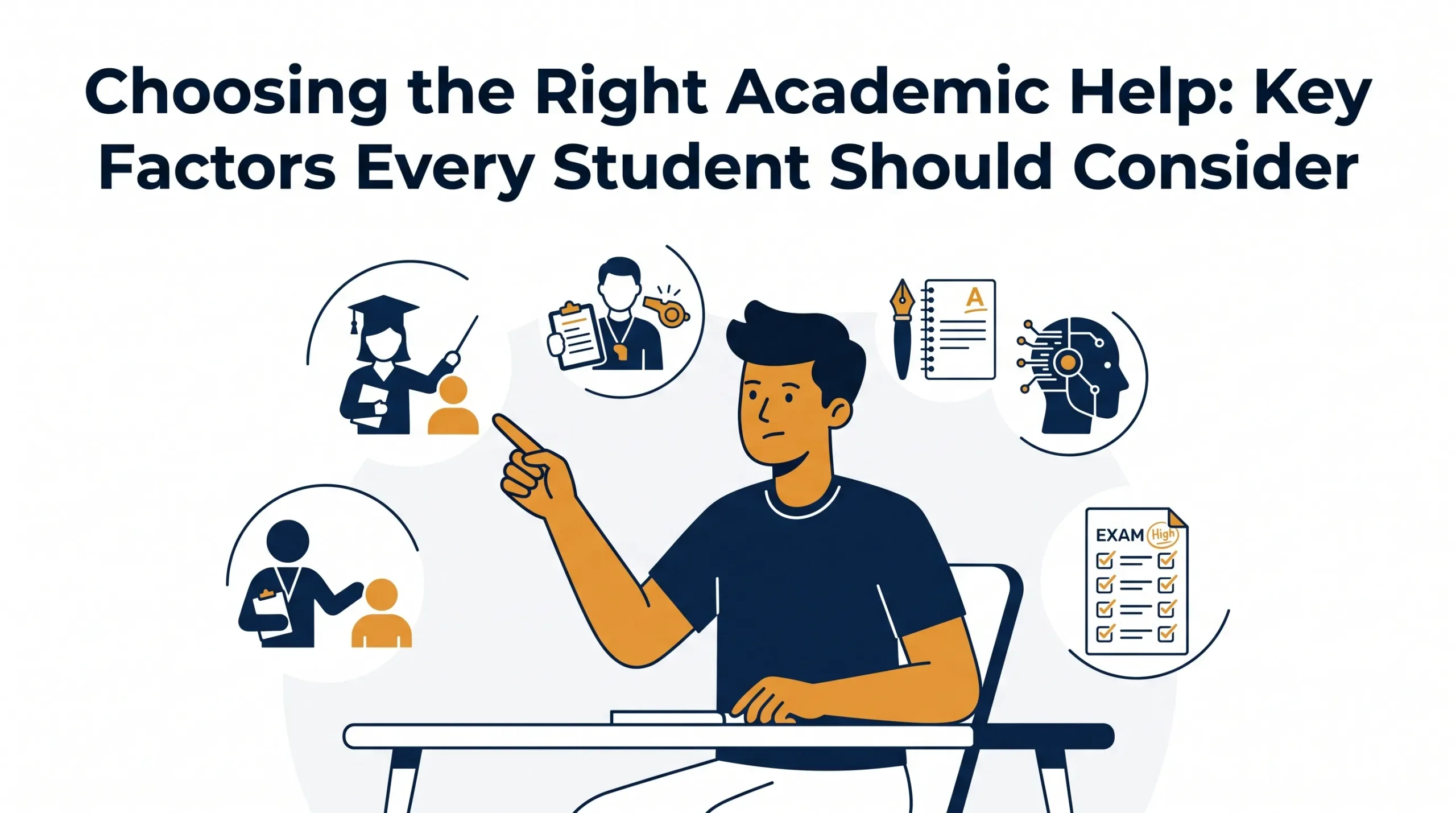
Students need different types of academic help depending on the gap between where they are and where they need to be. Subject-knowledge problems call for tutoring. Study-skills problems call for coaching. Writing problems call for a writing center or feedback-based support. Exam-preparation problems call for structured practice and mock testing.
Most students make one mistake when searching for help: they look for a tutor before they diagnose the problem. A student who understands chemistry but cannot manage revision time does not have a chemistry problem they have a time-management problem. Sending them to a chemistry tutor burns money without fixing anything.
There are six distinct categories of academic difficulty. Subject knowledge gaps mean a student cannot understand the core content. Study-skills gaps mean the student understands content but cannot retain or organize it. Writing gaps show up in essay structure, academic tone, argument development, and citations. Exam-preparation gaps appear when a student understands material but performs below their knowledge level under test conditions. Research gaps involve finding credible sources and applying citation styles correctly. Language gaps affect international students who need academic English development alongside subject content.
Identifying which category applies changes every decision that follows including whether the student needs paid help at all, or whether free university resources solve the problem first.
Which Academic Support Options Produce the Best Results?
Private tutoring, academic coaching, supplemental instruction programs, peer mentoring, and writing centers each target different problems and combining them based on a student’s specific needs consistently outperforms any single option used in isolation.
Private tutoring works best for subject-specific knowledge gaps where one-on-one explanation accelerates understanding. A student struggling with calculus concepts needs a tutor who has subject expertise in calculus at the student’s academic level not a general math tutor with no curriculum knowledge. Curriculum familiarity matters because assessments follow specific marking schemes, and a tutor unfamiliar with GCSE, A-Level, AP, IB, or undergraduate-level expectations teaches the wrong content at the wrong depth.
Academic coaching targets the broader picture. Unlike tutoring, coaching addresses time management, goal-setting, procrastination, and organization the behavioral patterns that block performance across every subject simultaneously. Students who use coaching alongside subject tutoring consistently outperform those who use either one alone. For students preparing for high-stakes exams, eexamly.com combines structured exam practice with the kind of performance feedback that coaching sessions reinforce.
Peer mentoring gives students something tutoring cannot: relatability. A peer who recently passed the same course knows the exact pain points, the tricky assessment criteria, and the study strategies that worked. Supplemental Instruction programs formalize this by pairing peer leaders with historically difficult courses, creating collaborative sessions that improve retention rates and reduce withdrawal numbers. Early alert systems at many universities track attendance, assignment completion, and early test scores to flag at-risk students before problems compound which is why using platform-based tools that track progress in real time adds a measurable safety net.
How Do You Evaluate a Tutor’s Qualifications?
A tutor’s qualifications should include a verified degree in the relevant subject, documented teaching experience at the student’s academic level, and familiarity with the specific curriculum being assessed.
Subject expertise and teaching ability are separate skills. A person who holds a PhD in physics is not automatically effective at explaining physics to a 16-year-old preparing for A-Level exams. The best tutors can identify misconceptions quickly, adapt their explanation when the student does not understand, ask questions that push the student to reason rather than just recall, and give feedback that explains what is wrong, why it is wrong, and how to correct it not just mark an answer as incorrect.
When evaluating qualifications, students should check three things. First, does the tutor have relevant education in the specific subject being studied? A strong tutor in economics is not automatically qualified to teach accounting or statistics. Second, does the tutor have experience with the same curriculum and assessment format? Third, can the tutor demonstrate or describe their teaching method not just their credentials?
A trial lesson answers all three questions faster than a CV does. During a trial session, a well-qualified tutor will assess the student’s current level, identify specific knowledge gaps, explain at least one difficult concept clearly, and outline a structured plan for future sessions. A tutor who rushes through content without checking understanding, or who does the work instead of teaching the student to do it, signals poor fit regardless of their qualifications on paper.
Does Teaching Style Actually Affect Academic Results?
Teaching style directly affects academic results because students process and retain information differently, and a teaching method that conflicts with a student’s learning pattern produces slower progress even with a highly qualified tutor.
Some students process concepts through visual diagrams and worked examples. Others need step-by-step verbal explanation. Others need to attempt problems first and receive feedback on their errors. A tutor who defaults to a single teaching method regardless of the student’s response misses a large proportion of learners. The key signal to watch during a trial lesson is whether the tutor adjusts their approach when the student does not understand or repeats the same explanation louder and faster.
Personality compatibility matters beyond methodology. A student who feels uncomfortable asking questions will not ask them and unasked questions become knowledge gaps that show up in assessments. A productive tutoring relationship requires the student to feel genuinely able to say “I don’t understand,” without hesitation. If a student leaves a trial session feeling more confused or more anxious than they arrived, the fit is wrong regardless of the tutor’s academic credentials.
The format of feedback also shapes outcomes. Good feedback names what is wrong, explains the underlying reason it is wrong, and gives the student a method to correct it independently next time. Feedback that only marks errors without explanation produces dependency rather than development. Students who learn to self-correct using their tutor’s framework become independent learners faster which is the actual goal of any academic support.
Online vs. In-Person Tutoring: Which One Delivers Better Outcomes?
Neither online nor in-person tutoring universally delivers better outcomes the format that produces better results depends on the student’s learning style, subject type, schedule constraints, and access to qualified tutors in their location.
Online tutoring removes geographic limits. A student in a small town can access subject specialists who would otherwise be unavailable locally. Screen sharing, digital whiteboards, and recorded sessions (where permitted) create learning resources the student can review after each session. Scheduling flexibility means sessions can align with exam timelines and deadline pressure rather than fixed weekly slots. For exam preparation specifically, online platforms like eexamly.com give students access to structured practice materials, progress tracking, and performance analysis tools that in-person sessions cannot replicate at the same scale.
In-person tutoring suits students who are distracted by screen environments, who benefit from physical demonstration (lab-based subjects, handwriting-intensive work), or who retain information better through direct human presence. The trade-off is a smaller pool of available tutors, less scheduling flexibility, and higher session costs in most markets.
The practical decision framework is straightforward. If the student has reliable internet access, a specific subject specialist in their location is unavailable or expensive, and their subject does not require physical materials, online tutoring produces equivalent or better outcomes at lower cost. If the student has documented difficulty focusing in digital environments, in-person sessions address that barrier directly and the focus improvement outweighs the format’s other limitations.
What Does Legitimate Academic Help Actually Look Like?
Legitimate academic help teaches a student to produce their own work at a higher standard it does not produce work for the student to submit as their own.
This distinction matters more than any other factor when choosing academic support. A tutor who explains how to structure an argument is providing legitimate support. A service that writes the argument and asks the student to submit it is contract cheating which universities classify as academic misconduct and penalize with grade penalties, suspension, or expulsion. The fact that a service markets itself as “tutoring” or “study support” does not change what it delivers.
Students should look for specific behaviors that confirm a service is legitimate. The service should ask about the student’s current understanding before providing any content. Sessions should teach concepts rather than deliver answers. Feedback on written work should identify problems and explain correction strategies not rewrite the work. Any service that offers to “do the assignment,” guarantees a specific grade, or advertises phrases like “100% undetectable” is a contract-cheating operation regardless of how it describes itself.
Red flags worth memorizing before choosing any provider: guaranteed grades, completed essays for sale, unsolicited social media messages offering assignment completion, no visible tutor qualifications, no clear pricing, no refund policy, and requests for university login credentials. Any one of these signals is enough to walk away. Academic integrity violations follow students into professional life a misconduct finding on an academic record affects graduate school applications, professional licensing, and employment background checks in many fields.
How Should Students Use AI Tools for Academic Help?
AI tools support legitimate academic learning when students use them to understand concepts, generate practice questions, get feedback on drafts, and build revision plans not to generate assessed content for submission.
The line is institutional, not technological. Many universities now permit specific AI uses for specific assignment types and prohibit others. A student who uses an AI tool to generate practice exam questions is using it as a study aid. A student who uses the same tool to write a graded essay and submits the output as their own work has committed the same violation as any other form of contract cheating. The tool is not the issue the use is.
Before using any AI tool for academic work, students should answer four questions: Does the institution permit AI for this specific assignment? Does the assignment require disclosure of AI use? Does the tool help the student learn, or does it bypass the learning entirely? Can the student explain and defend every part of the submitted work in their own words? A yes, yes, yes, yes pattern indicates legitimate use. Any no in that sequence is a signal to stop and clarify with the instructor before submitting.
For exam preparation specifically, AI tools that generate subject-specific practice questions, explain marking criteria, and identify knowledge gaps add measurable value. Platforms built specifically for exam practice like eexamly.com combine this functionality with structured progress tracking so students can measure improvement against their target grade, not just against their previous attempt.
How Do You Measure Whether Academic Help Is Working?
Academic help is working when a student demonstrates improving performance on assessments they complete independently, shows reduced dependency on the support provider over time, and can explain previously difficult concepts without prompting.
Grade improvement alone is an incomplete measure. Grades lag behind understanding a student can improve a grade through better exam technique without deeper comprehension, and can show deep comprehension that does not yet show up in grades due to exam anxiety or timing issues. The more reliable signals are: the student makes fewer errors of the same type session to session, the student self-corrects during sessions without waiting for the tutor’s feedback, and the student applies concepts from one session to new problems in the next without needing re-explanation.
If grades are not improving and comprehension is not improving after five to six sessions, the support type or provider needs to change. A subject tutor who produces no measurable progress after six weeks has either misdiagnosed the problem, is teaching at the wrong level, or is solving the assignments instead of building the student’s ability. Switching to a different format academic coaching if the issue is behavioral, or an alternative tutor with different curriculum knowledge typically produces faster results than extending a non-working arrangement out of loyalty or sunk-cost reasoning.
The final measure is independence. The goal of any academic support is a student who needs it less. A student who becomes more dependent on their tutor over time, rather than less, has a support arrangement that serves the provider’s billing model rather than the student’s academic development.