
Sitting down to do homework and actually doing it are two different things. You open your laptop, check one notification, and 40 minutes disappear. The problem isn’t your attention span it’s that nobody taught you how to set up the conditions for focus. This guide fixes that.
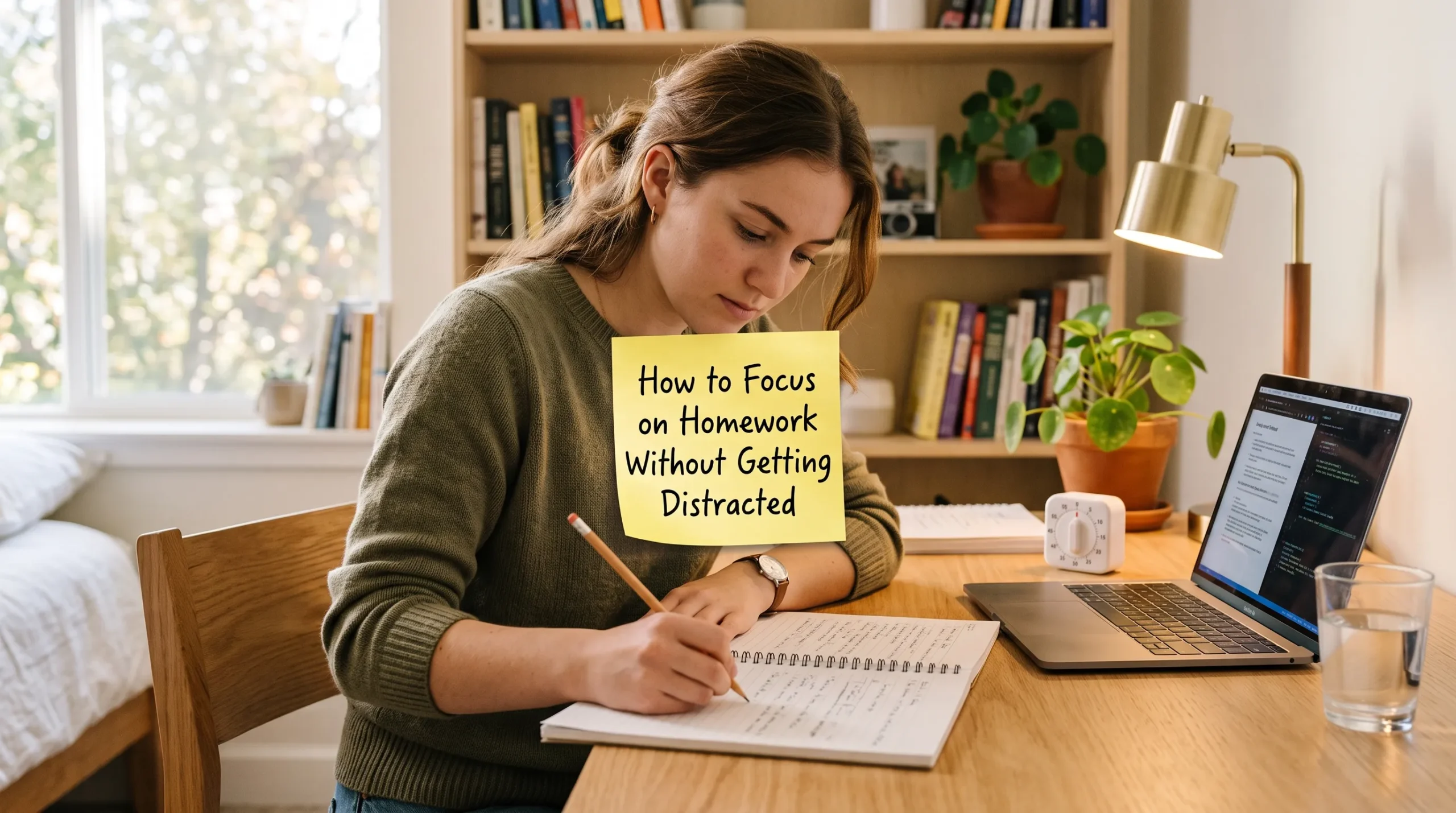
Clear your desk to what you need for this one task only. Put your phone in another room with Do Not Disturb on. Write down one specific micro-task not “do math homework,” but “solve questions 1 through 5.” Set a 25-minute timer and start before you feel ready. That loop, repeated, is how focused homework sessions actually work.
If that felt too simple, keep reading. The real blocker for most students isn’t the phone it’s that the assignment feels too big, too vague, or too anxiety-inducing even to touch.
Why Can’t You Focus on Homework No Matter What You Try?
You can’t focus on homework because the task in front of you is too vague, too overwhelming, or both. A brain facing an unclear goal defaults to avoidance and avoidance looks exactly like distraction. The phone, YouTube, and random thoughts are symptoms. The unclear task is the cause.
Most focus advice skips this entirely. “Put your phone away” doesn’t help when the root problem is staring at “write a 10-page paper” with no idea where to begin. Distraction fills the gap between where you are and where the assignment starts making sense.
There are two types of distractions pulling students off task, and they need different fixes.
What Are External Distractions During Homework?
External distractions are the ones you can see and touch your phone, open browser tabs, background noise, people talking nearby, and a cluttered desk. These are the easiest to remove because they are part of your physical environment. Move the phone, close the tab, and the distraction disappears.
The mistake students make is treating willpower as the solution. Willpower runs out. Environment doesn’t. If your phone sits face-down on your desk, your brain still knows it’s there every vibration pulls a fraction of your attention, even when you don’t pick it up.
The fix isn’t discipline it’s distance. Physical separation between you and the distraction is the only method that consistently works.
What Are Internal Distractions That Kill Homework Focus?
Internal distractions are harder to fix because they live inside your head. Intrusive thoughts, anxiety about the assignment, perfectionism, boredom, and mental fatigue all count as internal distractions and most study guides completely ignore them.
Perfectionism is particularly destructive. The thought pattern goes: “If I can’t do this assignment properly, I’ll start when I’m more prepared.” That moment never arrives. The avoidance compounds. By the time the deadline forces action, the anxiety is worse than if you’d started badly and improved.
The fix for internal distraction is structure, not motivation. When every next step is pre-decided, the brain stops generating escape options.
How Do You Set Up a Space That Actually Supports Focus?
Your study environment either works for you or against you there’s no neutral ground. A clean desk with only your current materials signals to your brain that this space means work. A desk covered in clutter, snacks, and your phone signals the opposite.
Before you sit down, prepare everything you need for the session: textbook, notebook, laptop, calculator, water, and a snack. The goal is zero reasons to get up once the timer starts. Every trip to the kitchen or bedroom resets whatever concentration you built.
Keep your study spot separate from your bed. The bed is where your brain associates rest and sleep. Studying on your bed trains your brain to feel sleepy when you open your notes which explains why so many students fall asleep mid-revision.
Does a Focus Anchor Help You Concentrate Faster?
A focus anchor is a sensory cue you use consistently at the start of every study session — the same desk lamp, the same playlist, the same hoodie. Over time, the brain learns that this specific combination means it’s time to work. The cue triggers the state.
This isn’t motivational advice it’s basic conditioning. The same mechanism that makes you hungry when you smell food makes you focused when you encounter your study cues consistently enough. Two weeks of repetition is enough for the anchor to start working automatically.
Lo-fi or instrumental music works as a focus anchor for many students. Lyrics pull your language-processing attention away from reading or writing tasks. Instrumental tracks fill silence without competing for the same cognitive resources your homework uses.
How Do You Stop Your Phone From Ruining Every Homework Session?
Put your phone in a different room not face-down on your desk, not in your bag, but physically out of reach. Research on smartphone proximity shows that even a phone placed face-down on a desk measurably reduces available working memory because part of your brain monitors it passively.
Do Not Disturb mode alone isn’t enough if the phone stays within arm’s reach. The habit of picking it up exists below the level of conscious decision. You reach for it before you realize you’re doing it. Physical distance breaks the habit loop before it starts.
For students who need a harder barrier, app blockers work where willpower doesn’t. Freedom, Opal, and Cold Turkey let you schedule blocks on specific apps during study hours. You can’t unlock Instagram mid-session even when you want to — the friction is the point.
What Is the One-Tab Rule for Studying on a Computer?
The one-tab rule means keeping only the single webpage or document you need for your current task open. Every extra tab represents a possible exit from your homework. Twelve open tabs are twelve escape routes your brain knows about.
Close everything except what the next 25 minutes requires. Download any resources you need before starting searching for “one thing” mid-session almost always ends with 20 minutes of unplanned browsing. Disable desktop notifications for the duration of your session.
Full-screen mode removes the taskbar, dock, and notification panel from view. Out of sight means out of mind for most students when it comes to digital distraction.
How Do You Break Homework Into Tasks Small Enough to Actually Start?
Break homework into tasks so specific that the first step takes less than two minutes. Not “study chemistry” but “open chapter 4 and read the first two paragraphs.” Not “write my essay” but “write one sentence for the introduction.”
The brain responds to completion signals. Finishing a small task triggers a dopamine release that builds momentum for the next task. Students who write micro-tasks before starting report fewer abandoned sessions than students who sit down with a vague subject goal.
Here’s what a broken-down task list looks like for a programming assignment:
- Open the assignment brief
- Read requirements once through
- Create the project folder
- Write the function skeleton
- Test input one
- Fix errors from test one
- Move to input two
Each step has a clear end point. When you finish step one, your brain registers completion and that feeling makes step two easier to start. For assignments that feel too large to break down at all, like dissertations or semester projects, Eexamly’s assignment help connects you with a subject expert who handles the scope while you manage what you can.
What Is the 5-Minute Rule for Starting Homework?
The 5-minute rule means telling yourself you’ll work for exactly five minutes, then stop if you want to. The commitment feels low enough that starting doesn’t trigger avoidance. In most cases, five minutes turns into twenty because momentum takes over once the task is in motion.
Pair the 5-minute rule with a single starting action: open the document, read the instructions, write one word. The psychological barrier to homework isn’t the work itself it’s the act of beginning. The 5-minute rule collapses that barrier by making the cost of starting feel small enough to accept.
Motivation follows action more often than it precedes it. Start badly, continue improving that sequence produces finished homework. Waiting for the right mindset produces nothing.
How Does the Pomodoro Technique Help You Stay Focused on Homework?
The Pomodoro Technique helps you stay focused by turning an open-ended homework session into a series of defined, timed blocks. Work for 25 minutes, break for 5 minutes, repeat. After four rounds, take a longer 20-30 minute break.
The technique works because “forever” feels impossible and “until the timer goes off” feels manageable. Students who use timed blocks report fewer mid-session phone checks because the break is already scheduled there’s no reason to steal one early.
25 minutes isn’t the only option. Complex assignments like programming, writing, or math often need longer focus windows. Try 40/10 or 50/10 if 25 minutes ends before you’ve built real momentum. The interval matters less than the principle: defined work period, defined break, no negotiating mid-block.
What Should You Do During a Pomodoro Break?
Spend your break doing something that doesn’t involve a screen. Walk to another room, drink water, stretch for five minutes, or look out a window. These activities let your prefrontal cortex rest without feeding it new stimulation.
Scrolling TikTok or checking Instagram during a break is not rest it’s a different type of stimulation that makes returning to homework harder. A 5-minute social media break regularly becomes 35 minutes because short-form video content is designed to extend session time.
The break is part of the method. Skipping it to push through leads to declining output quality in the next block. Taking it properly away from screens makes the next focus block start cleanly.
What Do You Do the Moment You Get Distracted Mid-Session?
Getting distracted mid-session doesn’t mean the session failed. Most students treat distraction as a reason to give up on the block entirely, which turns a 30-second distraction into a 40-minute one.
Use a distraction list. Keep a piece of paper beside you. The moment a thought interrupts “I should reply to that message,” “I need to check that price,” “I wonder what that actor’s name is” write it down. Don’t act on it. Writing it down tells your brain the thought has been logged and doesn’t need to stay active.
Return to exactly where you stopped. Not from the beginning — from the exact sentence, problem, or line you were on. Restarting from the top feels safer but wastes the work already done and delays the session further.
The 10-second reset:
- Notice the distraction
- Write it on the distraction list
- Close or remove whatever pulled you away
- Return to your exact stopping point
- Continue
The goal isn’t a distraction-free session. The goal is a session where distractions don’t stick.
How to Focus on Homework With ADHD
Students with ADHD can focus on homework by restructuring the environment more aggressively than standard advice suggests. Shorter work blocks, body doubling, pre-decided task lists, and external accountability work better for ADHD brains than motivation-based strategies. The environment does the work that willpower can’t.
ADHD doesn’t mean broken attention it means attention that needs more structure to stay directed. A neurotypical student might manage a 50-minute focus block with moderate effort. An ADHD student attempting the same block without support will spend most of it fighting their own brain. Shorter blocks win.
Start with 15 minutes on, 5 minutes off. Build from there only after 15-minute blocks feel manageable across multiple sessions.
What Is Body Doubling and Does It Help ADHD Students Focus?
Body doubling means studying in the presence of another person, physically or on a video call. The other person doesn’t help with the homework. Their presence alone increases task completion rates for ADHD students because the brain regulates attention differently when another person can observe behaviour.
A library, a coffee shop, or a study-with-me YouTube stream all produce a version of this effect. The key is another human presence, even a passive one.
Pre-loading the next session also helps. The night before, open your laptop, write tomorrow’s first task on a sticky note, and place it on the keyboard. When you sit down the next day, the decision about what to do first is already made. ADHD brains lose momentum in the gap between “sit down” and “figure out what to do” removing that gap removes the stall. For ADHD students whose assignments feel genuinely overwhelming, Eexamly’s online tutoring provides the external structure and one-on-one accountability that ADHD brains respond to best.
How Do You Stop Getting Distracted by Your Own Thoughts While Studying?
Intrusive thoughts during homework are a form of cognitive anxiety, not a character flaw. The brain generates escape thoughts when a task feels threatening too hard, too high-stakes, or too undefined. The fix is reducing task ambiguity, not increasing willpower.
When the assignment feels vague, the brain fills the gap with anything else. Thought loops like “what if I fail this,” “I should text them back,” or “I need to remember to do X later” are the brain’s way of avoiding a task it finds threatening. Writing those thoughts down immediately removes them from active memory.
The distraction list handles this directly. Every thought that pulls you away gets written down and shelved for after the session. Your brain stops looping on it because it trusts the written note to hold it.
How Do Implementation Intentions Stop Thought-Based Distraction?
Implementation intentions are pre-decided responses to specific interruptions. You decide in advance: “If I feel like checking my phone, I’ll write it on the distraction list.” “If I don’t understand a question, I’ll spend 10 minutes attempting it before stopping.”
Research on implementation intentions shows they reduce procrastination rates more reliably than motivation-based approaches. The reason: decision fatigue doesn’t apply to pre-made decisions. You’re not deciding in the moment you’re executing a rule you already set.
Write three implementation intentions before every session. Keep them specific. “If X happens, I will do Y” is the format. The more specific the trigger, the more automatic the response becomes over repeated sessions.
Why Does Sleep Affect Homework Focus More Than Any App or Technique?
Sleep deprivation reduces working memory, slows processing speed, and tanks sustained attention the three cognitive functions homework requires most. A student running on five hours of sleep applying Pomodoro blocks and app blockers will still underperform a rested student with no system at all.
Telling a chronically tired student to “focus harder” is like telling someone with a flat tire to drive faster. The physical state sets a ceiling on what any technique can deliver. No focus method overrides a depleted brain.
A consistent sleep schedule matters more than total hours alone. Going to bed at different times each night disrupts circadian rhythm, which controls when the brain enters its highest-performance states. Students who sleep inconsistently report more difficulty concentrating during daytime study sessions regardless of total sleep time.
Does What You Eat and Drink Change How Well You Can Focus?
Dehydration produces measurable cognitive decline before most people feel thirsty. A glass of water before sitting down to study isn’t a cliche it’s a direct input into how well your brain functions for the next hour.
Hunger spikes cortisol, which competes with the prefrontal cortex for resources. A brain managing hunger stress has less capacity for sustained attention. A light snack before a study session removes that competition. Heavy meals do the opposite digestion pulls blood flow and produces the post-lunch fatigue most students recognize.
Five minutes of walking between study sessions restores focus better than sitting still during breaks. Movement increases cerebral blood flow and resets the default mode network — the brain system that activates during mind-wandering. Students who walk between Pomodoro blocks return to homework with faster focus onset than those who sit passively.
Which Study Techniques Keep Your Brain Engaged Instead of Drifting?
The reason students drift mid-session isn’t always distraction — sometimes the study method itself produces boredom. Re-reading notes is passive. Passive tasks give the brain nothing to engage with, so it finds something else. Active study methods fix this by requiring output, not input.
The three techniques with the strongest evidence behind them are active recall, spaced practice, and single-tasking. Each one keeps the brain producing rather than consuming.
What Is Active Recall and How Does It Improve Focus?
Active recall means closing your notes and testing yourself on what you read, rather than re-reading until it feels familiar. After every section, close the book and answer: what were the main points? Can I explain this concept without looking? What questions does this material answer?
The cognitive effort of retrieval keeps attention engaged in a way that passive reading doesn’t. Students using active recall report fewer attention lapses mid-session because the task continuously demands output. There’s no opportunity to zone out when the next question is waiting.
Active recall also produces better retention. Students who test themselves during study sessions retain significantly more material at exam time than those who re-read the same pages multiple times.
How Does Spaced Practice Stop Last-Minute Cramming and Focus Burnout?
Spaced practice means distributing study across multiple short sessions over days rather than one long session the night before. A student studying biology across Monday, Wednesday, and Friday retains more than one who covers the same material in a three-hour Sunday session.
The focus benefit of spaced practice is that shorter sessions stay within a student’s genuine attention window. A 45-minute focused session beats a three-hour session where the last two hours are spent distracted and fatigued. Spacing prevents the burnout that destroys focus in long cramming sessions.
For subjects where the workload is too heavy to space out engineering coursework, statistics assignments, programming projects Eexamly’s subject-specific coursework help handles the volume so you can focus your study time where it produces the most return on your grades.
Why Does Single-Tasking Produce More Output Than Multitasking?
Single-tasking means one subject, one screen, one goal per session. Multitasking between homework, YouTube, messaging, and note-taking doesn’t save time it extends total task time because every context switch costs cognitive load to reverse.
Research consistently shows that task-switching reduces output quality and increases error rates. Students who believe they work better with background entertainment typically produce lower-quality work than when they single-task, even if the session feels more pleasant.
One task, one window, one outcome. That’s the whole system.
What Homework Focus Mistakes Do Most Students Keep Repeating?
The most common focus mistakes aren’t dramatic failures they’re small habits that compound into wasted sessions.
Phone face-down on the desk.
The phone is still present. The brain still monitors it. Face-down doesn’t remove the distraction it delays it by one step.
Social media during breaks.
A 5-minute TikTok break becomes 35 minutes because short-form content is engineered to extend watch time. Breaks should restore attention, not redirect it to something equally stimulating.
Waiting for motivation to start.
Motivation follows action it rarely precedes it. Students who wait until they “feel like” doing homework produce less work than students who start without that feeling and build momentum through the task itself.
Re-reading notes without testing.
Familiarity feels like learning but produces less retention than active recall. Re-reading notes for an hour is less effective than testing yourself for 20 minutes.
Spending more time planning than working.
A detailed colour-coded schedule isn’t homework completion. Forty-five minutes of organizing before starting is productive procrastination it looks useful but moves nothing forward.
All-nighters before deadlines.
A rested two-hour session produces better work than a sleep-deprived six-hour one. All-nighters consistently produce lower-quality output and damage focus capacity for the following two days.
A Complete Homework Focus Routine You Can Use Tonight
This routine pulls every technique from this guide into one repeatable sequence. Run it once tonight. Adjust the intervals based on what worked. Repeat until it’s automatic.
Before the session 5 minutes:
- Pick one specific task. Not “study.” Something measurable: “Complete questions 6 through 12” or “Write the introduction paragraph.”
- Prepare all materials before sitting down — book, notes, laptop, water, snack.
- Put your phone in another room. Do Not Disturb on.
- Close every browser tab except the one you need.
- Write your one goal on a sticky note and place it where you can see it.
- Write three implementation intentions on the same note.
During the session 25 to 50 minutes:
- Start the timer before you feel ready.
- Work on the single task only.
- Every interrupting thought goes on the distraction list — write it down, don’t act on it.
- When the timer ends, stop. Even mid-sentence. Stopping on time builds the habit of starting on time.
The break 5 to 10 minutes:
- Walk, stretch, drink water.
- No phone. No social media. No YouTube.
- Return when the break timer ends, not when you feel like it.
After the session:
- Check what you completed against your original goal.
- Write the first specific task for your next session before closing the laptop.
- That note is what you open to tomorrow — the decision is already made, the momentum already loaded.
Repeat the cycle two to four times per evening depending on your workload. Three focused 40-minute blocks produce more completed work than a four-hour unfocused session in most cases.
FAQs
Why can’t I focus on homework no matter what I try?
The most common reason is task ambiguity. When the assignment is vague or feels too large, the brain defaults to avoidance and that avoidance expresses itself as distraction. The fix is breaking the task into one specific, measurable first step before any focus technique will work.
If the task is clear and focus still doesn’t come, examine the physical environment: phone proximity, desk clutter, and sleep quality are the three most common hidden causes.
How do I stop getting distracted by my phone while doing homework?
Put it in another room not face-down on the desk. Add an app blocker like Freedom or Cold Turkey during study hours. The phone’s physical presence reduces working memory even when you don’t pick it up. Distance is the only reliable solution.
Does the Pomodoro Technique actually work for homework?
The Pomodoro Technique works because it converts an open-ended session into defined blocks. The 25/5 interval is a starting point, not a rule. Students doing complex assignments often get better results with 40/10 or 50/10. The principle matters more than the specific numbers.
How do I focus on homework when I’m genuinely exhausted?
A 20-minute nap produces more usable focus than two hours of tired studying. If sleep deprivation is chronic, no focus technique will fully compensate. Address the sleep first. If the deadline doesn’t allow that, reduce session length and increase break frequency short focused bursts outperform long exhausted ones.
What should I do if I get distracted mid-session?
Write the distraction on the distraction list, close whatever pulled you away, and return to exactly where you stopped not from the beginning. Getting distracted once doesn’t end the session. Staying distracted does.
How do I focus on homework with ADHD?
Use 15-minute focus blocks instead of 25. Study with another person present physically or on a video call. Pre-decide your first task the night before so there’s no decision gap when you sit down. If the assignments themselves are the barrier,Eexamly’s online tutoring provides the external structure and one-on-one accountability that ADHD students respond to best.
What if the homework is genuinely too hard to start?
Sometimes the problem isn’t focus it’s difficulty. A student staring at a statistics problem they don’t understand isn’t distracted; they’re stuck. Breaking the task down further helps, but if the material itself is the block, expert help moves faster than re-reading the textbook.Eexamly’s homework help connects you with subject specialists across mathematics, programming, engineering, and more who work through the assignment with you or handle it directly.
How do I stay focused on homework at home when the environment is noisy?
Noise-cancelling headphones with instrumental music create a portable focus environment. If the noise is conversational family, roommates, TV your brain’s language processing competes with reading and writing tasks. Instrumental tracks or white noise mask conversational interference without adding the same cognitive load.
How long should I study before taking a break?
25 to 50 minutes depending on the task and your current capacity. Shorter assignments or difficult new material benefit from 25-minute blocks. Longer writing or problem-solving sessions often need 40 to 50 minutes to reach productive depth. The break should always be active movement, water, rest not screen-based.