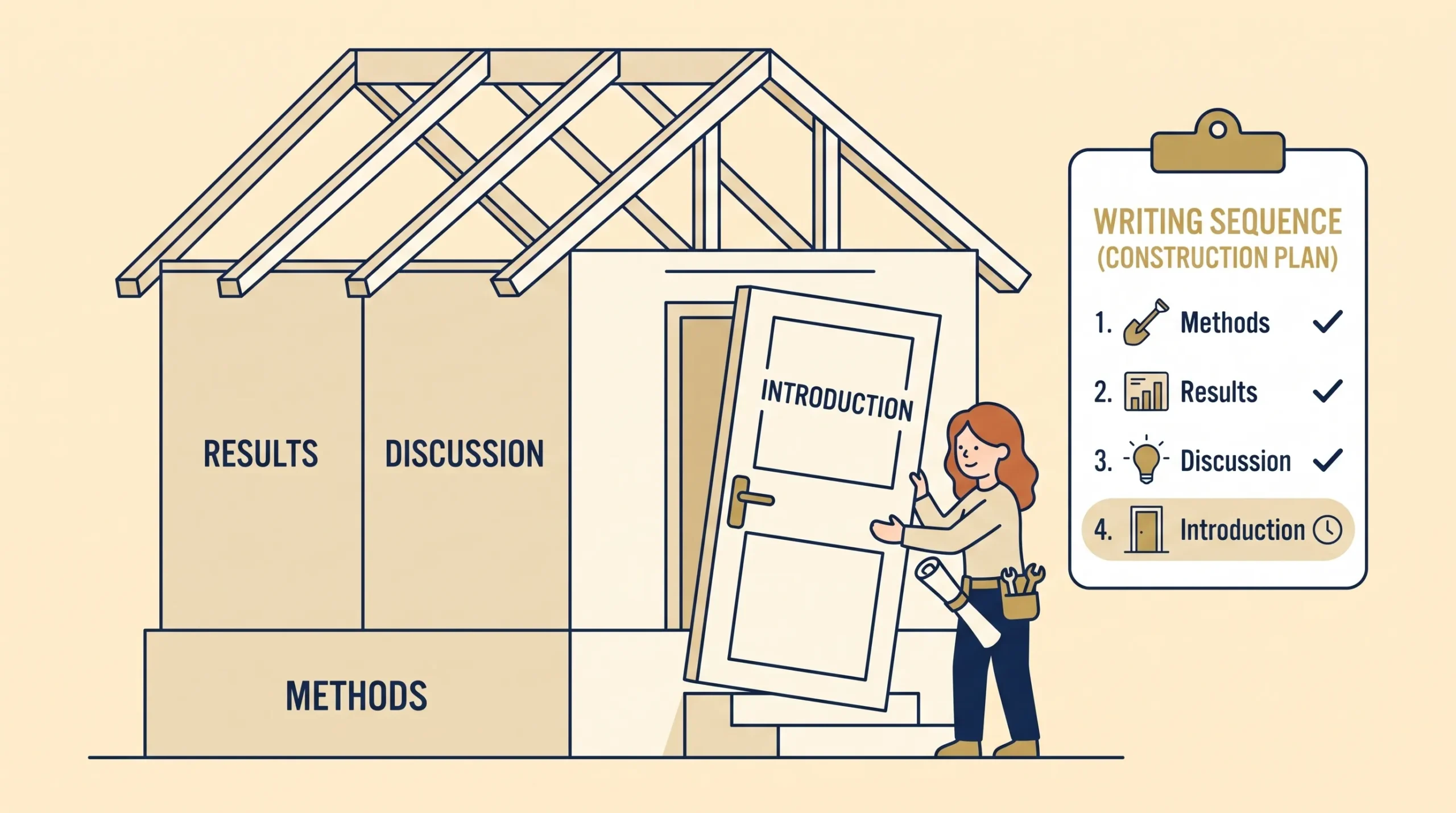

Writing a research paper fast comes down to sequence, not speed. Outline before typing, write body sections before the introduction, and separate drafting from editing entirely. Most writers lose hours to a broken workflow, not a lack of knowledge. The inside-out drafting method – body first, introduction last – removes the biggest friction point in the process.
Why Does the Order You Write a Paper Determine How Fast You Finish?
The order you write a research paper determines how fast you finish because the introduction can only accurately represent a paper that already exists. Starting with body sections removes ambiguity and gets words on the page immediately. Writers who draft the introduction first spend 1-2 hours rewriting it after the paper changes direction – which it always does.
Think of it like building a house. You don’t design the front door before the walls are up. The introduction frames what’s inside – write it after you know what’s inside.
Academic writing coaches, Reddit’s r/AskAcademia community, and published researchers all confirm the same sequence: body sections first, introduction last. This isn’t a workaround – it’s structurally correct.
The sequence matters even more for scientific papers. The IMRaD structure (Methods, Results, Discussion, Introduction, Abstract) exists for a reason. Methods describe what was done – there’s no interpretation required, which makes it the easiest section to write first. Results follow naturally because the data already exists. Discussion builds from results. Introduction frames everything after the argument is already visible on the page.
For general academic essays, the logic holds identically. Write body paragraphs in argument order, write the conclusion while the arguments are fresh, then write the introduction last to match the paper you actually produced.
The draft sequence feeds directly into the outline – and the outline is where fast paper writing actually begins.
How Do You Build an Outline That Makes the Draft Almost Automatic?
A flat outline converts a blank page into a structured map where every section, paragraph, and evidence point gets assigned before a sentence gets written. This makes the drafting stage mechanical rather than creative – which is faster. Most writers who struggle with paper speed skip this step and pay for it in rewriting time.
The outline doesn’t need to be elaborate. It needs to be complete.
What Does a Flat Outline Actually Contain?
A flat outline contains five elements per section: a one-sentence purpose statement for the section, the main argument per paragraph in bullet form, the evidence type needed (statistic, example, study finding), the source name or a TK placeholder, and a one-line note on how the paragraph connects to the thesis.
The TK placeholder technique appears consistently across Reddit’s r/lifehacks community and academic writing guides because it solves a specific problem. When a fact is missing mid-draft, most writers stop and search – breaking momentum and losing 15-30 minutes. TK marks the gap, keeps the draft moving, and creates a searchable term for the editing pass.
How Does the Outline Connect to Draft Speed?
An outline with specific paragraph assignments removes every micro-decision from the drafting stage. The writer knows what each paragraph argues, what evidence supports it, and where the source comes from before typing a word.
This is the difference between driving with a GPS and driving while reading a map. The destination doesn’t change – the cognitive load does.
Writers who complete a detailed outline before drafting consistently produce first drafts faster because they’re translating a plan, not building one mid-sentence. Tress Academic’s research on academic writing speed confirms that detailed outlining is the single highest-return time investment in the paper writing process.
The outline also surfaces structural problems before they become draft problems. A paragraph with no assigned evidence signals a weak argument before the writer has spent 45 minutes writing around it.
Which Section Should You Write First – and Why Is It Never the Introduction?
You should write the body sections or Methods first, never the introduction, because the introduction requires a complete understanding of what the paper argues – which only exists after the body is written. Writers who start with the introduction rewrite it after the rest of the paper changes their argument. That rewrite costs 1-2 hours on every paper.
For a standard academic essay, write body paragraphs in argument order. Each paragraph has one job: state the argument, present the evidence, explain why the evidence supports the thesis, and bridge to the next argument.
For scientific or research papers, the IMRaD sequence does this work structurally:
Methods – Written first. It’s a linear account of what was done. No interpretation, no argument – just procedure. Most researchers can draft this section in one sitting.
Results – Written second. The data already exists. The writing task is presenting findings clearly, referencing figures and tables that are already compiled.
Discussion – Written third. This section interprets the results. It states the main findings, acknowledges limitations, and explains the broader significance. The argument becomes visible here.
Introduction – Written last. With the Discussion complete, the writer knows exactly what claim the paper makes and what context the reader needs to understand it.
Abstract – Written after the Introduction. It summarizes a paper that now fully exists.
This sequence removes the biggest source of slow paper writing: writing a section before you have the information it requires.
For students managing coursework across multiple subjects simultaneously – particularly those enrolled through platforms like WGU, SNHU, or Capella – this sequence applies across paper types. The same inside-out logic that speeds up a biology research paper speeds up a business case study or a psychology literature review. Eexamly’s subject experts use platform-specific paper structures because the same approach that works on one system doesn’t always transfer directly to another.
The section sequence solves the order problem. The next bottleneck is the drafting stage itself – specifically, the habit that kills more papers than any other.
How Do You Separate Drafting from Editing So Neither Stage Slows the Other?
Drafting and editing use different cognitive modes. Drafting is generative – get ideas onto the page. Editing is analytical – evaluate and refine what’s there. Switching between them mid-sentence cuts output speed by more than half and produces work that’s neither a complete draft nor a clean edit.
The failure pattern looks like this: write a sentence, re-read it, change two words, re-read again, decide the whole paragraph needs restructuring, rewrite from the top. Four hours of this produces 400 usable words.
The fix is a three-pass system used across professional academic writing and validated through research on writing productivity:
Pass 1 – Draft pass: Write continuously. Use TK for missing facts. Skip the introduction. Don’t fix spelling. Don’t reword sentences. The only goal is a complete draft.
Pass 2 – Revision pass: Read the full draft for argument structure, logical flow, and paragraph order. Move sections if needed. Cut anything that doesn’t support the thesis. Add missing evidence slots.
Pass 3 – Edit pass: Work at the sentence level. Fix grammar, word choice, and citation formatting. Read the paper aloud – text-to-speech tools catch awkward phrasing faster than silent reading.
Each pass has one job. Mixing them produces work that fails at all three.
This three-pass model also applies directly to the final proofreading stage, which most writers rush because the deadline has already arrived. Eexamly’s proofreading and editing service handles this final pass on academic papers – particularly useful when the drafting stage ran long and the editing window collapsed to under an hour.
The draft-edit separation works because it matches the task to the mental state. You can’t critically evaluate an idea you haven’t finished expressing yet. Write the whole thing first. Then decide what to keep.
How Long Does Each Section of a Research Paper Actually Take?
Each section of a research paper takes a predictable amount of time when the outline is complete and sources are compiled. A 2,000-word academic paper takes 8-12 hours of focused work from outline to final edit. Without an outline or compiled sources, the same paper takes 16-22 hours – with most of that time spent on decisions the outline would have made before writing started.
The table below shows realistic draft times per section for a 2,000-word academic paper with a completed outline:
| Section | Draft Time |
| Flat outline | 20-30 min |
| Body paragraphs / Methods | 60-90 min |
| Results / Evidence | 30-45 min |
| Discussion | 30-40 min |
| Introduction | 20-30 min |
| Abstract / Conclusion | 15-20 min |
| Revision pass | 30-45 min |
| Edit pass | 30-40 min |
These times apply to a writer who has compiled sources before starting. Research collection – scanning abstracts, assessing relevance, extracting evidence by argument section – adds 2-4 hours for a 2,000-word paper and 6-10 hours for a 5,000-word paper.
Can You Write a 5-Page Research Paper in 2 Hours?
A 5-page research paper in 2 hours is achievable with a complete outline and compiled sources ready before the timer starts. Without both conditions met, 2 hours produces a rough draft – not a complete, citable paper. Budget 4-6 hours for a paper that’s ready to submit.
Can You Write a 1,000-Word Paper in One Day?
A 1,000-word paper takes 2-3 focused hours with a ready outline. One day is more than enough time – the risk is spending the available time on preparation that should have happened before writing started.
How Long Does a 20-Page Research Paper Take?
A 20-page research paper takes 20-35 hours of focused writing time from outline to final edit. Research collection adds 8-15 hours depending on source availability and topic depth. Most writers underestimate the research phase and run out of writing time as a result.
For students working 40+ hours a week alongside coursework on platforms like Sophia Learning, StraighterLine, or ALEKS, the math on available hours often closes before the paper does. The process described here requires 8-18 hours that have to exist somewhere in the schedule. When that time doesn’t exist, the process doesn’t break – the timeline does.
What Habits Make Paper Writing Slow – and How Do You Catch Them Early?
The habits that slow paper writing are process errors, not capability problems. They repeat on every paper because the writer never identified them as the source of lost time. Most slow writers mistake the symptom – a paper that takes 20 hours instead of 10 – for a writing skill problem when the actual cause is a sequencing error made in the first 30 minutes.
The five most common habits that extend paper writing time:
Writing the introduction first costs 1-2 hours of rewriting when the paper’s argument shifts during drafting – which it almost always does. Fix: write it last.
Editing while drafting caps output at roughly 400 words per hour. Fix: draft pass first, edit pass after the full draft is complete.
Researching without a thesis creates a research loop with no stopping point. Fix: write a working thesis before collecting sources, then research to support it.
Over-sourcing – collecting 30 sources for a paper that needs 8 – creates integration problems and slows the drafting stage. Fix: 6-10 quality sources per 2,000 words, organized by argument section in the outline.
Perfectionism in the draft stage produces papers that never get finished or get abandoned mid-draft. Fix: accept that a rough first draft is the goal of the drafting pass. The revision pass is where quality enters.
Identifying which habit applies takes one diagnostic: time the drafting stage alone, separate from research and editing. If drafting 1,000 words takes more than 90 minutes with a completed outline, the bottleneck is editing-while-drafting. If the outline stage takes over an hour, the research wasn’t organized before writing started.
For students who’ve identified the bottleneck but can’t solve the time problem – particularly those managing multiple courses simultaneously or facing hard submission deadlines – Eexamly’s thesis and research paper service assigns a subject-matched expert to handle the complete paper. Grades above 90% are the documented standard, and payment happens after the grade is confirmed – not before. Grade records across subjects including Engineering, Business, Computer Science, and Nursing are documented on the samples page, not presented as testimonials.
The habits section closes the process loop. What remains is the question most readers arrive with but don’t ask directly: what happens when the process is correct but the hours aren’t there?
When the Timeline Runs Out Before the Paper Gets Done
The writing process described above works. It cuts draft time in half for writers who follow the sequence consistently. But it still requires 8-18 hours of focused time – hours that have to come from somewhere.
For working adults enrolled in accredited online degree programs, those hours compete with 40-hour work weeks, family commitments, and simultaneous coursework across multiple platforms. Eexamly serves this specific profile: students who know the material, understand the deadline, and lack the hours.
The research paper and thesis service covers complete papers across 13+ subjects. Theessay writing service handles standalone academic essays when one section of a larger course creates the bottleneck. For papers that are drafted but need final review before submission, theproofreading and editing service completes the edit pass under deadline.
Every service operates on the same model: pay after the grade is confirmed, not before. Students considering whether the service fits their situation can read through how Eexamly approaches trustworthy online class help and review the criteria used to choose the right academic help before committing to anything.